


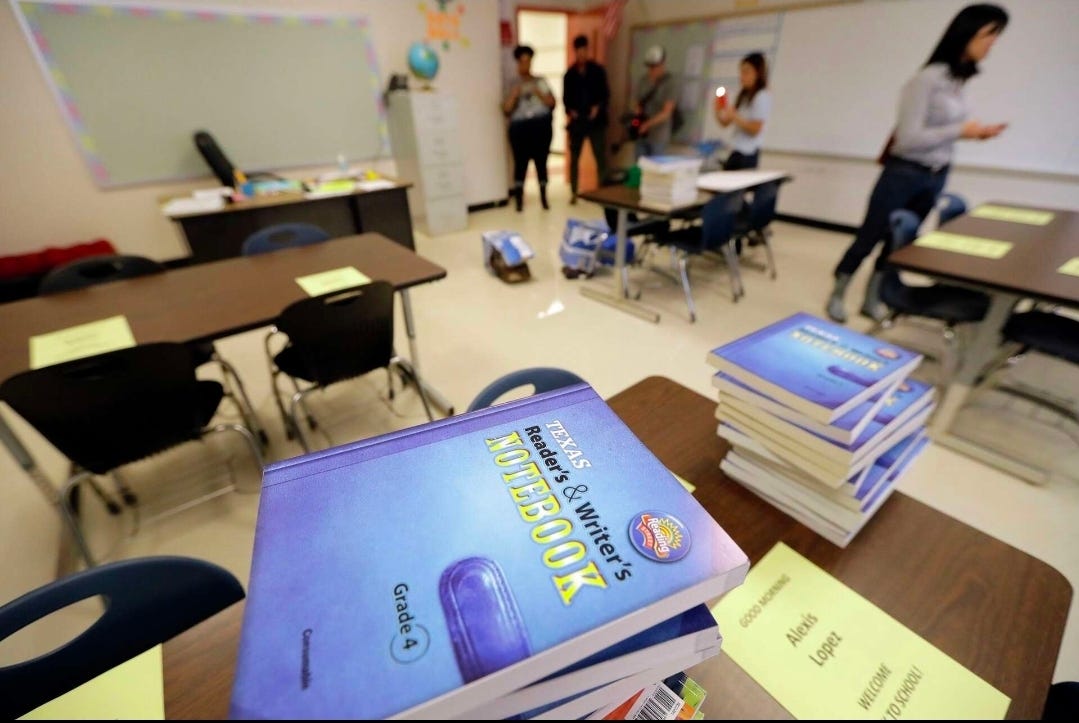
Texas has approved a statewide reading list that will make Bible passages required reading for millions of public school students.
The decision is being presented as a fight over literature, history, and classroom standards. But it lands inside a much larger political project. Texas is not introducing Christian scripture into public schools in a vacuum. It is doing so in a state where the same political infrastructure has already targeted trans students, immigrant families, racial history, public-school content, and the boundaries between church and state.
The Texas State Board of Education approved the required reading list in a 9–5 vote. The list applies to more than 5 million public school students and is scheduled to begin phasing in during the 2030–2031 school year. It includes Bible stories and passages alongside other required texts, making Texas one of the most aggressive state experiments in compulsory religious content in public education.
Supporters have argued that Judeo-Christian texts are historically significant and should be represented in classroom instruction. Critics have warned that the policy gives preference to Christianity, threatens church-state separation, and places one religious framework inside a public school system that serves children of many faiths and no faith.
The constitutional debate matters. But the public harm does not stop there.
The deeper issue is power. A state can say it is assigning scripture as literature while also using its schools to define whose values count as civic knowledge. Once a state requires children to read Christian texts as part of public education, the question becomes which children are expected to see themselves inside that moral framework and which children are expected to be corrected by it.
For trans students, that question is not abstract. Texas has pursued laws and policies restricting how schools discuss race, gender identity, sexual orientation, and identity-based inclusion. Across the country, Christian doctrine has also been used to justify bathroom bans, restrictions on gender-affirming care, book removals, pronoun fights, and policies that treat trans youth as problems to be managed instead of students to be protected.
When the same political movement advances those policies and then insists that Christian texts belong at the center of public instruction, vulnerable students have reason to hear more than a literary argument. They hear the state choosing a moral language that has already been used against them.
For immigrant students and families, the contradiction is also visible. Texas politics has repeatedly framed immigrant communities through enforcement, suspicion, border fear, and exclusion. The same political culture now asks public schools to elevate religious texts that include teachings about mercy, welcome, and loving one’s neighbor.
The problem is not that students may encounter the Bible as literature. Public schools can teach religious texts in appropriate historical, literary, or comparative contexts. The problem is compulsory state selection in a political environment where Christianity is not being treated as one tradition among many, but as the preferred moral language of public life.
Texas has already pursued a law requiring Ten Commandments displays in public school classrooms. That law has been challenged in federal court, with enforcement blocked in some districts at points while state officials pushed for compliance elsewhere. The reading-list approval now extends the same pressure into curriculum: not only what hangs on the wall, but what children are required to read.
The state’s public schools are also not demographically aligned with the narrow cultural vision being elevated. Texas public schools educate millions of children, and reporting on the new list has noted criticism that the selections lean heavily on older works, many by white male authors, in a state where Latino and Black students make up a majority of public-school enrollment.
That does not mean every old text is harmful. It means required reading lists are never neutral. They tell children what a state believes is essential, worthy, civilizing, and authoritative.
When a state with Texas’ political record chooses Bible passages as mandatory public-school reading, the choice carries the weight of that record. It follows years of fights over race, gender, sexuality, immigration, censorship, parental control, and the meaning of public education itself.
The classroom becomes the place where political power turns itself into common sense. The state does not only pass bans or restrictions. It builds curriculum. It chooses texts. It defines heritage. It tells students which stories belong to the center and which stories can be treated as optional, controversial, or dangerous.
For vulnerable children, that distinction is material. A trans child sitting in a Texas classroom may already know that state leaders have debated their body, their name, their bathroom, their healthcare, and their place in school. An immigrant child may already know that the same state speaks about families like theirs through the language of border control and criminalization. A non-Christian child may already know that the classroom is supposed to belong to everyone, not only to the faith tradition most favored by the state.
Compulsory Bible reading enters that room with all of that already present.
The hypocrisy is not hidden. Christian scripture includes commands to love one’s neighbor, care for the stranger, protect the vulnerable, and show mercy. But those teachings are not what define the state’s treatment of many of the children most likely to be harmed by its politics. The state is not asking whether its policies reflect those teachings. It is asking children to accept the texts while adults in power continue to build systems that punish the neighbors those texts claim should be loved.
The issue is not only religion in schools; it is the use of public education to launder political cruelty through moral language.
Texas officials and supporters can describe the Bible passages as heritage, literacy, or historical context. But public schools are not private churches, and children are not an audience captured for state-backed religious formation. A classroom serving millions of students should not be used to elevate one religious tradition while the state’s politics continue to mark trans students, immigrant families, non-Christian children, and students of color as problems to be governed.
The reading list is scheduled years in advance, but the signal is immediate. Texas is telling the country that public education can be used to normalize Christian authority at scale.
The consequences extend far beyond Texas. The state educates roughly one in ten public school students in the United States. Its curriculum decisions influence textbooks, publishers, political copycats, and national debates over what children are allowed to learn.
The question is not whether the Bible can ever be studied in public school. The question is why a state already targeting vulnerable children is so determined to make Christian scripture compulsory.
Public education should protect students, not turn classrooms into testing grounds for state-backed religious politics.
Support RESIST | FIGHT’s work documenting how power moves through schools, courts, agencies, and public systems.
Upgrade to support the work ↓
I hope The Satanic Temple gets involved like they have in other states to put an end to the bs. They have been successful in many lawsuits.
From their website:
The mission of The Satanic Temple, a religious organization, is to encourage benevolence and empathy among all people, reject tyrannical authority, advocate practical common sense, oppose injustice, and undertake noble pursuits. The Satanic Temple has publicly confronted hate groups, fought for the abolition of corporal punishment in public schools, applied for equal representation when religious installations are placed on public property...
I hope The Satanic Temple gets involved like they have in other states to put an end to the bs. They have been successful in many lawsuits.
From their website:
The mission of The Satanic Temple, a religious organization, is to encourage benevolence and empathy among all people, reject tyrannical authority, advocate practical common sense, oppose injustice, and undertake noble pursuits. The Satanic Temple has publicly confronted hate groups, fought for the abolition of corporal punishment in public schools, applied for equal representation when religious installations are placed on public property...